
MCB vs RCCB: Difference & Why Your Home Needs Both
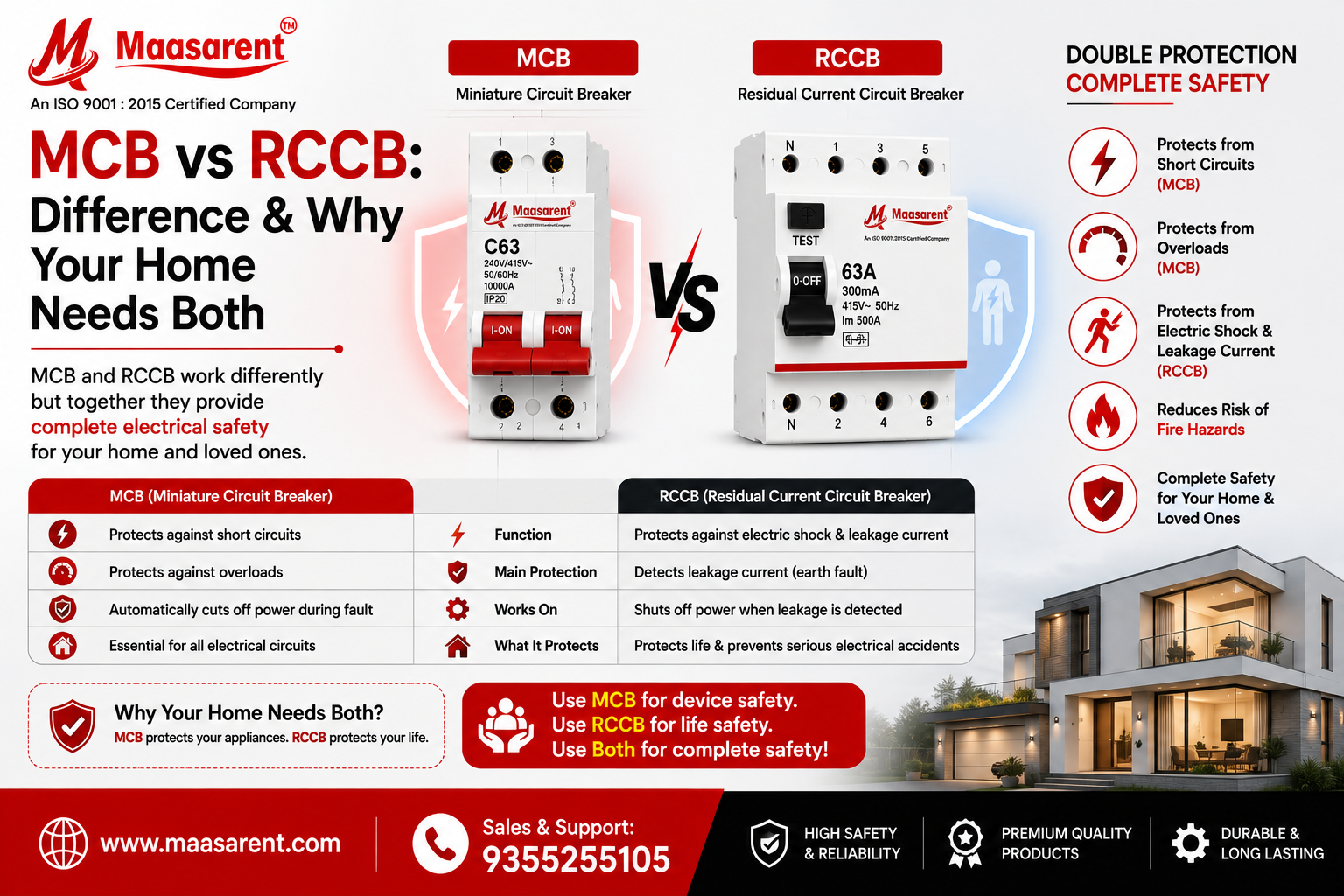
MCB vs RCCB: What's the Difference and Why Does Your Home Need Both?
Understand the different roles of MCBs and RCCBs and why both can play an important part in a safer home electrical system.
```Quick Answer: An MCB primarily protects electrical circuits from overloads and short circuits, while an RCCB detects residual or leakage current. Because they protect against different electrical hazards, an appropriately designed home electrical system may use both devices together.
What Is an MCB?
MCB stands for Miniature Circuit Breaker. It is a protective switching device commonly used in residential electrical installations. Its primary purpose is to protect a circuit from excessive current caused by conditions such as an overload or short circuit.
For example, if too many appliances are connected to a circuit and the current exceeds the circuit's designed capacity, the MCB can trip and interrupt the supply. It can also disconnect the circuit when a short circuit occurs.
By interrupting excessive current, an appropriately rated MCB helps protect electrical wiring and connected equipment from damage caused by overcurrent conditions.
MCB in Simple Words
Think of an MCB as protection against too much current. It responds primarily to overload and short-circuit conditions.
What Is an RCCB?
RCCB stands for Residual Current Circuit Breaker. Unlike an MCB, an RCCB is designed to detect an imbalance between the current flowing through the live conductor and the current returning through the neutral conductor.
If some current flows through an unintended path to earth, the RCCB can detect this residual current and disconnect the circuit when the leakage reaches its operating threshold.
This type of protection is particularly important because an earth-leakage fault can create an electric shock hazard even when the current is not high enough to operate a conventional overcurrent protective device.
RCCB in Simple Words
Think of an RCCB as protection against current leakage. It monitors the electrical balance and can disconnect the supply when residual current is detected.
MCB vs RCCB: What's the Difference?
The easiest way to understand the difference is to look at the type of electrical fault each device is designed to detect.
| Feature | MCB | RCCB |
|---|---|---|
| Full Form | Miniature Circuit Breaker | Residual Current Circuit Breaker |
| Main Protection | Overload and short circuit | Residual/earth leakage current |
| Primary Purpose | Protects the circuit and wiring from overcurrent | Provides additional protection against leakage-related shock hazards |
| Response | Trips when excessive current is detected | Trips when residual current reaches its operating threshold |
Why Does Your Home Need Both?
MCBs and RCCBs protect against different types of electrical faults. This is the main reason they should not be treated as interchangeable devices.
An MCB is designed to respond to overloads and short circuits, while an RCCB focuses on residual current and earth leakage. An RCCB by itself does not provide the same overcurrent protection as an MCB.
Therefore, where an RCCB is used, it normally needs appropriate overcurrent protection, such as an MCB or fuse, as required by the electrical design and device specifications.
Two Different Jobs, One Safer System
```MCB → Helps protect against overloads and short circuits.
RCCB → Detects residual current and helps provide additional protection against leakage-related shock hazards.
```A Simple Home Example
Imagine a washing machine develops an insulation fault and some current begins leaking to earth. The leakage may not necessarily create enough overcurrent to make the MCB trip.
An appropriately selected RCCB can detect the residual current and disconnect the supply when its operating threshold is reached. On the other hand, if a circuit becomes overloaded or experiences a short circuit, the MCB is designed to respond to that overcurrent condition.
This illustrates why the two devices can complement each other in a properly designed electrical installation.
What About RCBO?
Another option is an RCBO (Residual Current Circuit Breaker with Overcurrent Protection). An RCBO combines residual-current protection with overload and short-circuit protection in a single device.
Depending on the electrical installation, an RCBO can provide individual circuit protection and may be useful where selective protection or panel space is important. The appropriate solution should be chosen according to the installation design and applicable requirements.
How to Choose the Right Protection?
Electrical protection devices should never be selected only on price. The correct device depends on factors such as circuit load, current rating, system configuration, installation conditions and applicable electrical standards.
- Choose the correct MCB rating for the circuit and wiring.
- Select an RCCB with suitable ratings and residual-current sensitivity.
- Ensure proper earthing and wiring practices.
- Use compatible protection devices according to manufacturer specifications.
- Have electrical installation work performed by a qualified professional.
Build a Safer Home Electrical System with Maasarent
```Reliable electrical protection starts with choosing the right devices for every circuit. Explore Maasarent's range of electrical protection solutions for modern homes.
Explore Maasarent ```Final Thoughts
MCBs and RCCBs are not competing devices—they are designed to address different electrical risks. An MCB primarily protects against overload and short-circuit conditions, while an RCCB detects residual current and provides an additional layer of protection against leakage-related shock hazards.
For many residential electrical systems, using appropriate overcurrent and residual-current protection together can create a more comprehensive approach to electrical safety. Always select and install protection devices according to the specific installation requirements and applicable standards.