
How to Choose the Right MCB for Your Home: A Complete Guide
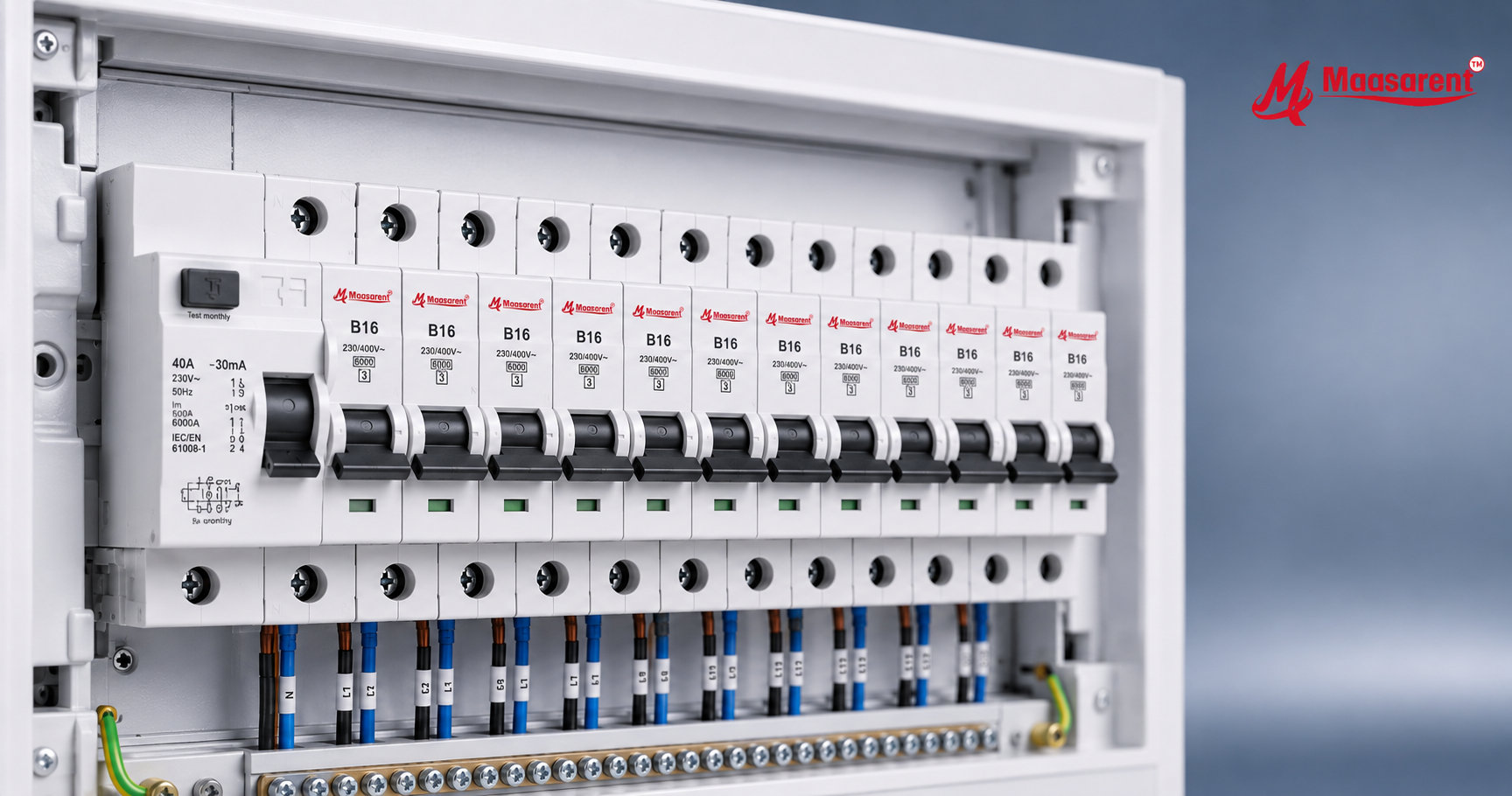
The MCB (Miniature Circuit Breaker) is the small switch inside your distribution board that protects your wiring and appliances from overload and short circuits. Choosing the right one is not complicated once you understand three things: current rating, number of poles, and tripping curve.
1. Pick the correct current rating (Amps)
The rating should match the wire size and the load. As a rough home guide: 6A–10A for lighting circuits, 16A for general power sockets, 20A–25A for geysers and heavy sockets, and 32A+ for air conditioners or kitchens. An MCB that is rated too high will not trip in time; one rated too low will nuisance-trip.
2. Choose the right number of poles
Single Pole (SP) is used for individual lighting or socket circuits on single-phase supply. Double Pole (DP) disconnects both live and neutral and is ideal for the main incomer or heavy appliances. Triple Pole (TP) and Four Pole (FP/TPN) are used for three-phase loads.
3. Understand the tripping curve
B-Curve MCBs trip faster and suit resistive loads like lights, fans and sockets — perfect for most homes. C-Curve MCBs tolerate higher inrush current and suit motors, pumps and air conditioners.
4. Don't ignore breaking capacity (kA)
Breaking capacity is the maximum fault current the MCB can safely interrupt. For homes, a 10kA MCB is a safe, reliable choice.
Quick checklist
- Match the Amp rating to the circuit load
- Use SP for lights/sockets, DP for the main and heavy loads
- B-Curve for homes, C-Curve for motors
- Choose 10kA breaking capacity for peace of mind
Every Maasarent MCB is ISO 9001:2015 manufactured and built to keep your family safe. When in doubt, ask a licensed electrician to confirm the load before buying.